If you’re planning to take the TOEFL iBT in 2026, you’re in for some changes. ETS has rolled out significant updates that shift the test closer to how English is actually used, both in university settings and everyday life. The familiar four-section structure remains (Reading, Listening, Speaking, Writing), but the tasks themselves look noticeably different, with new question types designed to test practical communication skills alongside traditional academic English.
The changes aren’t cosmetic tweaks. ETS has introduced entirely new task formats across all sections, added adaptive testing in Reading and Listening, and implemented a dual scoring system that reports both traditional scores and CEFR-aligned proficiency bands. The Speaking section now tests pronunciation through listen-and-repeat tasks and conversational ability through simulated interviews. The Writing section includes sentence construction, email writing, and academic discussion—a far cry from the essay-heavy format of previous years.
Whether you’re a first-time test taker or retaking after preparing for an older format, understanding these updates is essential. Here’s a complete breakdown of what to expect and how to prepare.
2025 vs. 2026: What Changed at a Glance
Before diving into each section, here’s a quick comparison of the key differences between the 2025 and 2026 TOEFL iBT formats:
| Section | 2025 Format | 2026 Format |
| Reading | Academic passages only; standard multiple-choice questions | Adaptive; adds Complete the Words and Read in Daily Life tasks; mixes academic + everyday texts |
| Listening | Lectures and conversations; standard comprehension questions | Adaptive; adds Listen and Choose a Response task; tests conversational appropriateness |
| Speaking | 4 integrated tasks; opinion + reading/listening synthesis | 2 task types (11 questions): Listen and Repeat + Take an Interview |
| Writing | 2 tasks: Integrated essay + Academic Discussion | 3 task types (12 questions): Build a Sentence + Write an Email + Academic Discussion |
| Scoring | 0-120 total score | 0-120 total score + 1-6 proficiency bands per section (CEFR-aligned) |
For a detailed breakdown of all the new task types and scoring changes, see the complete 2026 TOEFL format guide.
Reading: Academic Texts Meet, Real-World English
The Reading section sees some of the most significant changes in the 2026 update. It now contains roughly 35–48 questions and is fully adaptive, meaning your performance on earlier questions shapes which questions come next. But the bigger shift is in content: you’ll encounter both traditional academic passages and practical, everyday texts like emails and announcements. This dual focus reflects how university students actually use English—reading research papers one moment and scanning a campus notice the next.
Complete the Words
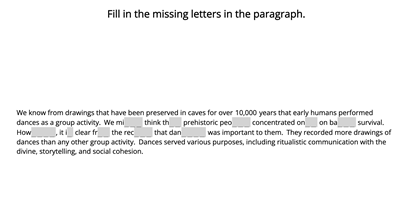
This entirely new task type presents a short paragraph of around 70 words with missing letters in several words. Your job is to type the missing letters to complete each word correctly. With typically around 10 blanks per task, this tests a combination of skills that traditional multiple-choice questions can’t measure: spelling accuracy, vocabulary depth, grammar awareness, and your ability to use context clues to predict what words should appear. You’ll need to pay careful attention to word forms (is it “develop” or “development”?) and how each word fits the sentence’s meaning.
Read in Daily Life
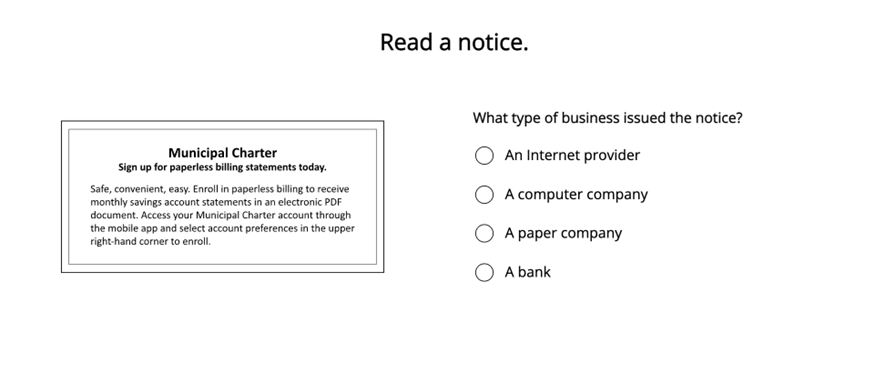
This task type represents ETS’s push toward practical English assessment. You’ll read short, realistic texts—emails from professors, campus notices, social media posts, event flyers, or advertisements—and answer multiple-choice questions about their purpose, intended audience, key details (dates, prices, locations), and simple inferences. Unlike academic reading, which tests your ability to follow complex arguments, this task tests whether you can quickly extract useful information from the kinds of texts you’ll encounter daily in an English-speaking environment. Speed and practical comprehension matter more than deep analysis here.
Read an Academic Passage
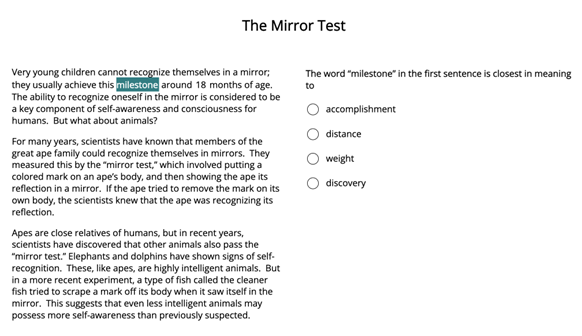
This task will feel familiar if you’ve prepared for older TOEFL formats. You’ll read longer passages on topics from science, history, or social science and answer questions about main ideas, supporting details, vocabulary in context, and how arguments are organized. The skills tested here—identifying thesis statements, understanding how examples support claims, inferring meaning from context—remain central to academic success. What’s different is that this task now shares space with more practical reading, so you’ll need to shift gears between analytical reading and quick-scanning skills.
Listening: One Shot, No Replay
The Listening section contains 35–45 questions and is also adaptive. The fundamental challenge remains unchanged: you hear each recording only once, and once you move forward, there’s no going back to previous questions. What’s new is the addition of conversational response questions that test whether you understand not just what people say, but what would be appropriate to say back. This shift toward testing real-world communication skills means you’ll need strong listening comprehension alongside an intuitive feel for natural English interaction.
Listen and Choose a Response
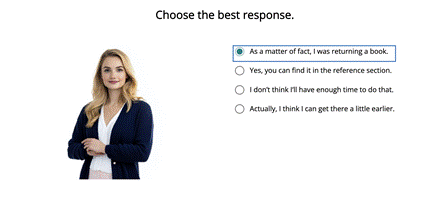
This new task type plays a short line or mini-dialogue, then asks you to choose the most natural response from four options. It tests conversational English—your ability to understand requests, offers, complaints, and questions, and to recognize what sounds polite, logical, and contextually appropriate. For example, if someone says “I can’t believe the library closes at 6 on Fridays,” you need to recognize whether the appropriate response expresses sympathy, offers a solution, or asks for clarification. This is less about vocabulary and more about understanding conversational intent and social dynamics.
Conversations
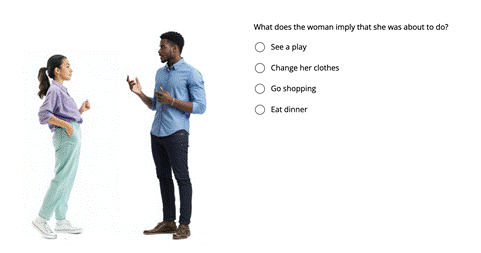
You’ll listen to short dialogues, usually between students or between a student and campus staff like an advisor or librarian. Questions focus on what speakers want, what decisions they make, and why certain things are said. The emphasis is heavily on implied meaning and practical decision-making in campus situations. You might hear a student negotiating a deadline extension or trying to resolve a housing issue, and you’ll need to understand not just the literal words but the underlying concerns and outcomes. Strong note-taking skills are essential since you can’t replay these conversations.
Announcements and Academic Talks
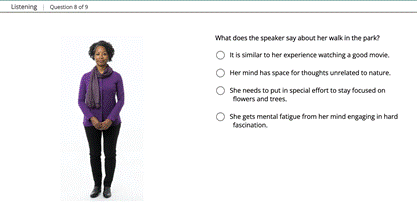
Longer recordings similar to short lectures make up this portion of the test. You’ll hear academic talks on various subjects and campus announcements about events, policies, or procedures. Questions focus on main ideas, supporting examples, and speaker purpose or attitude. This task is the closest to traditional TOEFL listening and tests the same skills you’ll need in university lecture halls: following extended speech, identifying key points, and understanding how speakers structure their explanations. The recordings may feature different accents and speaking speeds, so exposure to varied English speakers during preparation is valuable.
Speaking: Listen, Repeat, and Interview
The Speaking section has been completely redesigned for 2026. Gone are the four integrated tasks that asked you to synthesize reading and listening passages into spoken responses. In their place, ETS has introduced a simpler but more direct assessment of your spoken English: 11 questions across just two task types. This new format tests pronunciation, fluency, and conversational ability in a much more straightforward way—can you accurately reproduce English sounds, and can you respond naturally in a conversation?
The shift reflects a practical reality: universities care whether you can be understood and whether you can participate in discussions. The new format tests exactly those skills without the added complexity of reading-listening integration.
Listen and Repeat
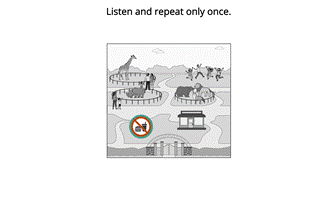
In this task type, you’ll hear a phrase, sentence, or short passage and repeat it as accurately as possible. This directly tests your pronunciation, intonation, rhythm, and ability to accurately produce English sounds. It might seem simple, but accurately repeating natural English speech—with correct stress patterns, connected speech, and appropriate pacing—is genuinely challenging for non-native speakers. The task reveals whether you can hear and reproduce the sound patterns of English, which is fundamental to being understood in academic and professional settings.
Success requires training your ear to notice details: where native speakers place stress in a sentence, how words connect and blend together, and how intonation rises and falls to convey meaning. Students who have spent time shadowing native speakers—listening and immediately repeating what they hear—tend to perform well on these tasks.
Take an Interview
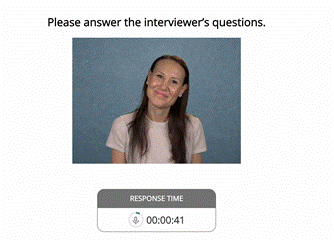
This task simulates a real conversation by having you answer questions from an interviewer. You’ll hear questions on various topics—likely including personal experiences, opinions, and hypothetical scenarios—and respond naturally. Unlike the old independent speaking task where you had 15 seconds to prepare a structured response, this format rewards genuine conversational ability: the capacity to understand a question, formulate a relevant answer, and deliver it fluently without excessive hesitation.
The interview format tests skills that matter in real academic life: participating in discussions, answering professors’ questions, and engaging in the kind of back-and-forth conversation that happens constantly on university campuses. Strong responses will be relevant, reasonably detailed, and delivered with natural fluency—not necessarily perfect grammar, but clear communication that would be understood by any English speaker.
Writing: Sentences, Emails, and Discussions
The Writing section has also been substantially redesigned. Instead of two essay-style tasks, the 2026 format features 12 questions across three distinct task types. The new structure tests a broader range of writing skills—from basic sentence construction to practical email writing to academic discussion—reflecting the diverse writing demands students face in university life. You won’t just be writing essays; you’ll demonstrate that you can construct grammatically correct sentences, communicate effectively in everyday situations, and contribute meaningfully to scholarly conversations.
This variety means you need different skills for different tasks. Some questions test grammar and syntax at the sentence level, others test practical communication, and others test your ability to form and support academic arguments. Prepare accordingly.
Build a Sentence
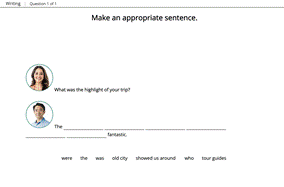
This task type asks you to create a grammatically correct sentence, likely from given words or prompts. It tests your understanding of English syntax—word order, subject-verb agreement, tense consistency, article usage, and how different parts of speech fit together. While this might seem basic compared to essay writing, constructing grammatically accurate sentences is the foundation of all good writing. Many test takers who can produce long essays still make fundamental grammatical errors that this task type will expose.
The task rewards precision. You’ll need to understand not just vocabulary but how English grammar actually works at the structural level—something that extensive reading and deliberate grammar study both support.
Write an Email
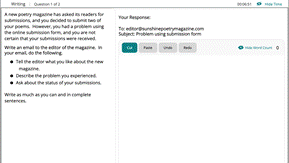
This practical task asks you to write an email using information provided in the prompt. You might be asked to respond to a situation, make a request, provide information, or address a problem—the kinds of emails students write constantly in academic settings. Success requires understanding the appropriate register (formal vs. informal), organizing information clearly, and including all relevant details from the prompt.
Email writing tests practical communication skills that the old TOEFL format largely ignored. Can you write a clear subject line? Do you know how to open and close an email appropriately? Can you be concise while including necessary information? These skills matter enormously in university life, where you’ll email professors, administrators, classmates, and potential employers regularly.
Write for an Academic Discussion
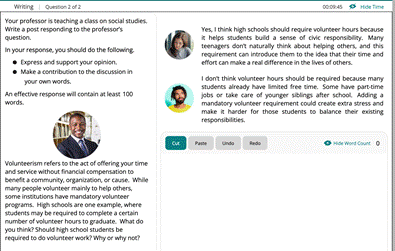
This task carries forward from the previous TOEFL format. You’ll respond to a forum-style prompt where a professor poses a question and several students have already posted responses. Your job is to write your own contribution, stating a position and supporting it with reasons and examples. You’re encouraged to engage with other students’ ideas—agreeing, disagreeing, or building on their points—rather than writing in isolation.
This task mirrors how academic discussion actually works in university courses that use online forums, and it tests your ability to join an ongoing intellectual conversation constructively. The best responses don’t just state an opinion; they acknowledge what others have said and position their own argument in relation to the existing discussion. This requires reading carefully, thinking critically, and writing persuasively under time pressure.
The Bottom Line
The 2026 TOEFL iBT isn’t a completely different test, it’s a meaningful evolution that better reflects how English is actually used in academic and daily life. If you’ve prepared for older versions, the core skills still apply: reading comprehension, listening for main ideas and details, speaking clearly under pressure, and writing organized arguments. What’s changed is the emphasis and variety.
ETS is now explicitly testing whether you can handle English as it’s actually used—reading a quick email as competently as an academic article, understanding a casual conversation as well as a formal lecture, responding naturally in both everyday and scholarly contexts. The adaptive format means the test adjusts to your level, and the new proficiency bands make scores more interpretable. Together, these changes aim to answer a practical question: are you ready for real life in an English-speaking academic environment?